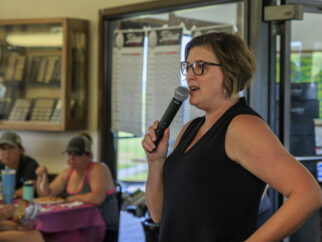
This is the story of her survival. A North Dakota girl, through and through, Amy was born in Minot and raised in Glenburn. She earned a degree in elementary education from Minot State University, plus a master’s degree from North Dakota State University in school counseling. Amy spent nine years working in the TGU School District, ultimately choosing to stay home and raise her family in Bottineau.
Married to her husband Pat since 2008, local Bank President and small grain farmer, Amy has since been what she likes to call a “professional volunteer” and is actively involved in the community. Aside from raising their daughters, you can find Amy selling cabi clothing, as the Summer Rec “Chaos Coordinator” and President of the Bottineau Figure Skating Club. Calling herself a professional volunteer might have been an understatement with how much time Amy has given to the community.
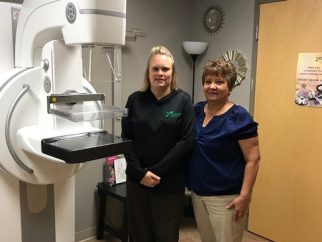
When Amy was 39, however, her life took a turn and began to change. It all started when Tim Bedell, MD, Trinity Health OB/GYN, suggested that Amy should get a mammogram. Initially, Amy felt like that was unnecessary.
“I thought it was ridiculous and unnecessary. I’m 39, I have no family history of cancer or genetics. I felt like there was no indication that I would be a young cancer patient,” said Amy. Dr. Bedell, however, let Amy know that it was important to have a mammogram to establish a baseline for future exams. Begrudgingly, Amy decided to oblige.
That mammogram took place in the spring of 2018. With a clear mammogram, Amy had no worries to consider after it was done. She then got a letter in the mail in May of 2019 saying it was time to schedule her yearly mammogram. Of course, this would just be as routine as the first, or so she thought.
Going into the second mammogram, Amy felt much more prepared, and she felt like this was something that she and Dr. Bedell would be able to talk about during her regularly scheduled appointment which was set to happen in June. But then the phone rang five days after the mammogram.
“I got a call within five days of the mammogram and, you know, they said this is precautionary and it happens to a lot of women. His nurse said there was not anything to panic about, but she told me they saw a couple of things that they wanted to look into more,” said Amy.
Immediately after the phone call, Amy could tell something seemed different. She began to wonder what they could have possibly found while also keeping in mind that it could be precautionary and might not be anything.
The diagnostic process began, which included a diagnostic mammogram, an ultrasound and a breast biopsy. Then came the news that changed her life forever: she had invasive ductal carcinoma, or breast cancer.
“I got the phone call on June 21 when I was driving near the Minot Air Force Base and I remember hearing the voice say, ‘Amy, it is Dr. Bedell. I am so sorry; I hate this kind of phone call.’ I remember thinking I had 12 minutes to get my act together before I had go pick up our kids and pretend that nothing was going on. It was a very surreal and weird thing.”
Amy added, “it was very stunning. I think there is a shield of armor that goes around you from the minute you hear that news until you can let yourself let it down, which was quite some time for me. It is a lot of information, fear and worry. I just kept wondering if this was really happening.”
After getting some time to process everything and to tell her loved ones, Amy and her family started determining a treatment plan by meeting with surgeons and oncologists. By the middle of July of 2019, she knew what she was up against and what the road ahead looked like.
During that process, she received advice from Jerel Brandt, DO, a general surgeon with Trinity Health, that helped her out a lot in her journey.
“Dr. Jerel Brandt gave me the best advice and I share it with everyone when I tell my story. He said, ‘your emotional urgency is far greater than your physical urgency.’ I took that small peace of mind to every single appointment. When you hear you have cancer, you just want it out and you want to be done. But you have to trust the process. Tests and treatment plans take time to create.”
When it came time to determine the treatment plan, everything was established with Trinity Health in Minot. Since Trinity Health is a member of the Mayo Clinic Care Network, there was further consultation completed with Mayo Clinic in Rochester, Minn.
One day after her 41st birthday, Amy began chemotherapy at the Trinity Health CancerCare Center. She admittedly was in the “anger stage” of her recovery journey. Amy shared that the stages of grief follow the same patterns in cancer as they do in any loss.
The early stages of that process were rough, as Amy recalls feeling sick, miserable and crying all the time. She then transitioned from the TCHP chemo regimen to weekly Taxol chemo, before eventually having to face what people call the “red devil.” The “red devil,” also known as Adriamycin, is a chemotherapy medication that gets its nickname because of its color and the wicked side effects that it can cause.
Amy, however, referred to the “red devil” as “big red” instead because she didn’t think the medication deserved to be called anything else. She remembers begging her oncologist to give her anything but the “red devil” when switching her course of treatment. However, it was in fact the best course for treating her cancer. “That pretty much wiped out my entire immune system and put me in the hospital for five days when I was done with it, and that one was pretty wicked,” said Amy.
Once Amy finished her chemo treatments, it was time for the next step which was surgery. With Trinity Health and Mayo Clinic teaming up for Amy’s treatment plan, this meant heading to Rochester in February of 2020 for a double mastectomy. Amy’s cancer was classified as Stage 3 with 15 affected lymph nodes. Upon a successful surgery, Amy was declared cancer free as of February 5, 2020.
“When you are halfway, or what you think is halfway into your treatment, you kind of just become numb to all of it and you are more concerned with surviving than you are with the processing or any of the real emotional stuff, so I was very glad to have that procedure done and to get the cancer out of my body.”
With five weeks of proton therapy treatments coming up next, Amy, her parents and her two daughters moved to Rochester temporarily in April of 2020 while her husband stayed home to work. Making this time even more difficult was the fact that all these major life changes were happening during COVID which created even more uncertainty. Luckily, there were no changes to Amy’s treatment during this time.
“I was lucky enough that I was able to continue with my proton treatment. We chose that treatment with the recommendation of my oncologist because my tumors were very close to my heart and lungs. Proton treatment is a narrowly targeted form of radiation using proton beams for fewer side effects and precision in treating critical areas.”
Amy added, “it was a great treatment at Mayo Clinic and I’m very thankful for the partnership between Trinity Health and Mayo Clinic. Every step of the way my plan was reviewed by Mayo’s experts and Trinity’s experts, and it was agreed upon using the most current research and protocols. I felt super comfortable being treated at home or close to home.”
The end of the five weeks of proton therapy treatments also meant it was the end of Amy and her girls having to live in Rochester and be away from her husband. While Amy was looking forward to heading back home, it was a bittersweet moment for her to leave Rochester.
“It was bittersweet. I will hold Rochester as a community dear in my heart for many reasons. It’s a medical treatment-based community and they cater to their patients. We liked the house we were in and we liked going to Flapdoodles which is their famous ice cream shop,” said Amy.
Amy added, “my mom, dad, the girls and I joked that we kind of ate our feelings in ice cream at Flapdoodles. You have to find the humor in all of this. We laughed and we have some good memories during different treatments. We were so happy to come home and have our family all together again, and yet, I just felt a little bit of sadness and gratitude for the place that was such a big part of my treatment. Cancer patients feel uncomfortable when the safety of treatment plans are done. It’s a strange mix of fear and excitement that only cancer patients can understand.”
Amy continued her treatment in Minot with 14 treatments of Kadcyla. Her active treatment now includes daily medication in combination with a shot once a month to provide hormone suppression. Amy will be five years cancer free in February of 2025.
Throughout her journey, Amy learned a lot about herself, as she says, “there is life before cancer (BC) and life after cancer (AC). I am not the same person as I was in 2019. Cancer changes everything. I have to be grateful for all of it. I have learned to take better care of my mental health which has been huge. We are super busy people here. Our kids are active in a lot of things, and we are as well. Regaining my energy has been a major obstacle in recovery. This is probably the year that I have felt more distant from any symptoms of cancer treatment than I have felt in a long time. It just continues to improve as my energy improves.”
Amy added, “occasionally someone will say, ‘think about what you have been through with your body. It has been a war, and it takes a while to recover.’ I try to remind myself of that and give myself grace, but overall, my health is really good, and I’m really pleased with where I’m at.”
Despite being happy with her health, Amy acknowledges that there will always be fear and worry, with recurrence at the top of that list. During those moments, she makes sure she speaks with her oncologist to talk things through, and they will get a scan if they feel like it is necessary.
“I once thought the cancer treatment lasted a short amount of time and then it is over. I now realize that this will be the rest of my life. I am very open with my cancer journey, which I hope will help someone else who might be facing something similar.”
Looking back on her journey, the message of hope and maintaining a positive attitude played a big role in helping Amy get to the point where she is today. Even though there are plenty of hard moments during her battle with cancer, finding hope and finding the good in each day helped her in the healing process.
“You have to find the time to laugh, even when it is not easy. Laughter is really good for the soul and it might be the best medicine.”
For those who are going through a similar situation as Amy, her advice for how to manage it is simple: find people you can lean on and make sure you understand that you are not alone.
“Find your support system, whether it is family or not. Finding someone who can be with you during each step and someone who can support you is huge. Never go to treatments or appointments alone. Finding someone who is a second set of ears helps too because there were many times where I wanted to just run right out of the room rather than listen.”
Through Amy’s journey she not only emerges as a survivor, but also as a source of hope and inspiration for others who are facing their own battles.