• Skip to primary navigation
  • Skip to main content
  • Skip to primary sidebar

Trinity Health

Close Search

How can we help you?

Popular Searches...
  • Find a Doctor
  • Find a Location
  • Find a Job
  • Pay My Bill
  • View Patient & Visitor Information
  • Access Patient Portal
  • Make a Donation
  • Contact Trinity Health
  • Find a Provider
  • Find a Location
  • Areas of Care
  • Patients & Visitors
  • My Patient Portal
  • Pay My Bill
  • Ways to Give
  • News & Events
  • Careers
    Home
  • Archives for 3D mammography

3D mammography

Samantha Morgan Turns Passion into Purpose at Trinity Health


October 30, 2025

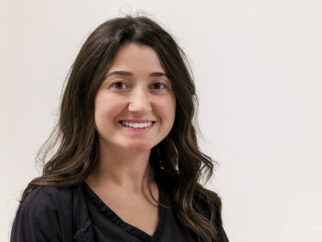
Towards the end of her college career, Samantha Morgan knew the career path she wanted to follow; she just needed to determine how to get there. After graduation, Samantha began working in admitting at Trinity Health. This, she felt, was a great opportunity to get her foot in the door before ultimately reaching her goal of enrolling in the Radiologic Technologist program at Trinity Health.

After more than a year of working in admitting, Samantha applied to the Radiologic Technologist program and was accepted. Following a successful completion of the two-year program, which Samantha balanced while continuing to work in admitting, she was offered a position as a Mammography Technologist with Trinity Health.

This was a significant milestone in Samantha’s life. One that she had dreamt about for a long time. “When I was in high school, I initially thought being a radiologic technologist would be one of the coolest jobs. I was very fascinated by anatomy, and I thought being an X-ray tech would be something I would like to do for the rest of my life,” said Samantha.

She added, “When I was in college, I kind of changed career paths, but in my final year, I decided that I definitely wanted to work in radiology. Once I started pursuing that route, I learned about the different modalities available to registered technologists, and mammography was one of them. I thought mammography checked all the boxes of what I truly wanted to do.”

For Samantha, her passion for mammography comes from understanding how important these moments are and how much of a difference compassionate care can make for someone facing the unknown.

“When patients come in, you want to provide a good experience for them, right? Nobody wants to come in for a mammogram, so being the first person they see and providing them with a great experience can make a difference,” said Samantha.

She added, “When they have to come back for additional images if there is a finding, it’s generally the same person who does those extra views. For the patients, they are going through something pretty traumatic, but they feel a little more comfortable by seeing a familiar face. I knew I could be someone who provides a great experience for our patients.”

Samantha’s commitment to providing exceptional care and her passion for helping others didn’t go unnoticed. Just a few months after graduating and stepping into her new role as a Mammography Technologist, she was offered the opportunity to take on a leadership position with Trinity Health Mammography.

That position is her current role, where she serves as Mammography Tech Supervisor. It’s a position that brings her both pride and fulfillment, knowing the impact her team makes on patients every day.

“I take great pride in my work. I see students who show interest in mammography, and I get to introduce them to what the department and field are all about. Mammography can be very challenging when you’re just starting out. When you can’t get the perfect image for the radiologist, it can be frustrating. I enjoy supporting my team during these times and helping them learn, grow and build confidence,” said Samantha.
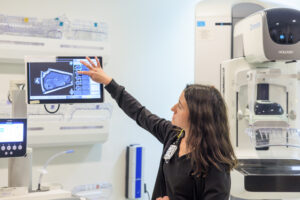
As Samantha reflects on how far she has come, she’s equally as energized by where the field is heading. Advancements in mammography technology, including innovative equipment now available at Trinity Health, are opening new doors for earlier detection and enhanced patient comfort.

At Trinity Health, those advancements are already making an impact. Thanks to strong community support and major fundraising events from Trinity Health Foundation, patients now have access to advanced 3D Mammography™ technology. This state-of-the-art system produces clearer images in a fraction of the time, reducing compression from about 40 seconds to under 10.

“Every day, I have patients tell me their mammogram experience this year is much better than last year. They even say it feels like we don’t have to compress as hard. Even though we do compress the same, it’s just a shorter amount of time. Most importantly, they say they will see us next year,” said Samantha.

With each milestone, Samantha has learned just how much opportunity exists within Trinity Health, especially for those willing to work hard and chase their passion. It’s a message she’s eager to share with others who are considering their own path forward.

“Going above and beyond is my top advice. Let your leaders know you’re interested in advancing, so they can help guide and prepare you if the opportunity arises. Lastly, don’t hesitate to take risks. I started my position very new, and I took a chance. There were some challenges along the way, but I was able to show I was ready for my role,” said Samantha.

Samantha’s path demonstrates what’s possible when passion meets opportunity. Whether working directly with patients or guiding the next generation of technologists, she is committed to advancing care and helping others see the career potential within Trinity Health.

Filed Under: HealthTalk Tagged With: 3D mammography, mammogram, national breast cancer awareness month, Trinity Health mammography, Trinity Health radiology

Trinity Health Foundation Unveils New 3D Mammography™ Technology


August 15, 2025

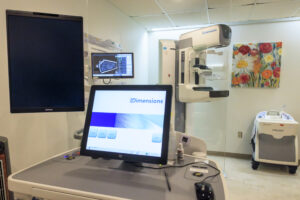
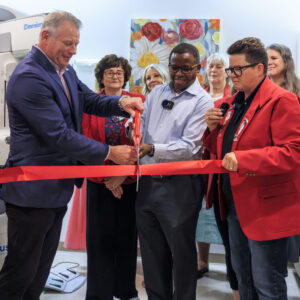
Thanks to various donations from donors, as well as events like Double D-Haw, the Trinity Health Foundation Fundraising Gala, Building Hope Women’s Golf Tournament and Chopper Drop, Trinity Health Foundation is proud to announce the availability of advanced 3D Mammography™ at Trinity Health, which will be transformative for breast care throughout the region.

This state-of-the-art technology produces higher-quality 3D images, provides a more comfortable experience, and offers faster and more accurate screenings, as well as biopsy capabilities. While compression used to take about 40 seconds per image, Trinity Health can now get images in less than 10 seconds. Additionally, this technology has been proven to detect an average of 41% more breast cancers compared to 2D alone, reducing patient callbacks by 40% and leading to less patient anxiety, better outcomes and peace of mind.

“The overwhelming support from our donors and the community made it possible to bring cutting-edge technology like the Genius ™ 3D Mammography™ exams to Trinity Health. This investment will significantly improve the patient experience and advance early detection and diagnosis, ultimately saving lives and transforming breast care for women in our region,” said Dusty Zimmerman, Director of Trinity Health Foundation.

The arrival of a 3D Mammography™ exam marks a major step forward in the fight against breast cancer. By providing clearer imaging, quicker results and greater comfort, this technology gives women across the region a stronger chance at early detection—when treatment is most effective. It’s a significant advancement in helping to save lives and supporting better outcomes for patients.

Filed Under: News Releases Tagged With: 3D mammogram, 3D mammography, mammogram

Being Aware of Breast Cancer


October 3, 2018

In 2017, about 9,700 mammograms were performed throughout Trinity Health.

In August 2017, Cary Hutchins of Williston went in for her mammogram — her first, in fact — at Trinity Community Clinic-Western Dakota. Since she did not have a history of breast cancer in her family, Hutchins, then 56, figured that a mammogram “wasn’t something I was going to do.”

However, when Heather Riely, BSRT(R)(M), RDMS, the radiology supervisor at Western Dakota, approached her about getting one done, “we scheduled something,” Hutchins said. “And as it turns out, they actually found something.”

According to the National Breast Cancer Coalition, more than 75 percent of women with breast cancer have no family history of the disease. However, family history is still a risk factor. A family history would include having two or more first-degree relatives — a mother, sister or daughter — or second-degree relatives — an aunt, niece, or grandmother — who have had breast cancer.

When the results from Hutchins’s mammogram came back, it was determined that a biopsy was needed. The report for the biopsy indicated invasive ductal carcinoma. Invasive ductal carcinoma (IDC) is the most common form of breast cancer; about 8 of every 10 invasive breast cancers are invasive ductal carcinomas, the American Cancer Society said. IDC starts in the cells that line a milk duct in the breast, breaks through the wall of the duct, and grows into the nearby breast tissues. “At this point, it may be able to spread — or metastasize — to other parts of the body through the lymph system and bloodstream,” the ACS said on their website.

Thankfully, in Hutchins’s case, it was caught soon enough. The carcinoma included “two little modules. They were so small, I would have never felt it myself,” she said. Thankfully, the 3D mammography technology could detect them. “They were really tiny.”

Hutchins had more tests done to pinpoint where exactly the ICD was, consulting with Madhu Unnikrishnan, MD, an oncology with Trinity CancerCare Center. Before long, on October 25, 2017, she was in surgery, where she had a lumpectomy; a lymph node was also removed “just to make sure it hadn’t gone any further.”

Since then, her follow-up appointments have gone well, with scans showing no signs of cancer.

“Trinity was absolutely wonderful,” Hutchins added. “My care from beginning to end included a good support team and great nurses.”

According to the Centers for Disease Control and Prevention, the number of new cases of breast cancer have increased slightly over the years. The ACS estimates that about 266,120 new cases of invasive breast cancer would be diagnosed in women this year. Additionally, about 63,960 new cases of carcinoma in situ (CIS), a non-invasive and earliest form of breast cancer, would be diagnosed, and about 40,920 women would die from breast cancer in 2018.

Men make up less than one percent of breast cancer cases. Men have less breast tissue than women, which would logically lower the risk of men developing breast cancer. However, the risk is still there and many men ignore the symptoms — lumps, inverted nipples, nipple discharge, and open sores (specifically on the nipple) — shrugging it off as a disease that only women could get.

Mammograms are important because they can help detect cancer early when it is most treatable.

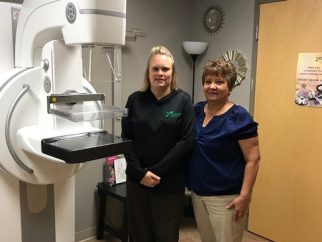
Since 2015, the Wide-Angle True Breast Tomosynthesis, the most up-to-date 3D breast imaging system on the market, has been available for patients at Trinity Health. At Western Dakota, the recent addition of technologists to help facilitate smooth scheduling has helped patients get timely mammograms.

“Everybody’s loving that,” Riely said, noting that patients have expressed their positive feelings about the technology. Riely agrees. “We’re finding cancer early.”

The 3D technology helps detect small nodules, especially in dense breast tissue which had previously presented a problem in diagnosis. Women with dense breast tissue have a greater chance of developing breast cancer or a greater chance of the breast cancer potentially being missed, Riely said. The 3D mammograms give doctors a greater ability to detect and diagnose those tumors; target the size, shape, and location of the tumors overall; and rule out abnormalities that might otherwise be deemed suspicious, thus reducing the need for additional testing, which can be worrisome to patients.

The procedure takes a little longer than a standard mammogram because the camera is taking multiple exposures while the breast is compressed, but the resulting images are a good compensation. “The amount of information you get for that long exposure is well worth it,” explained Connie Busch, RT(R), Lead Mammographer with Trinity Health’s Breast Imaging Center, in Minot.

“It wasn’t what people say. I don’t feel that they are painful,” Hutchins added.

The 3D technology creates 3D images from the 25 exposures of the breast with a wide 50-degree arc. These images are then assembled into a 3D study to see the breast tissue, layer by layer, in fine detail. Should a patient need an excisional biopsy of lumpectomy, in the event the mammogram detects something, the process can now be completed more quickly thanks to this technology.

Knowing what she knows now, Hutchins agrees that a mammogram is worthwhile.

“It’s not worth not having one done,” she said. “Whether you are thinking you don’t have a family history of it, you should just go and get it done. In the long run, early detection is key. Get in, get it done, and you’l feel much better.”

To schedule a mammogram, call Trinity Health’s Mammography Scheduling line at 857-2640, or in Williston at Trinity Community Clinic – Western Dakota, at 774-0810.


Filed Under: HealthTalk Tagged With: 3D mammogram, 3D mammography, breast cancer, Cary Hutchins, Connie Busch, family history, Heather Riely, IDC, invasive ductal carcinoma, Madhu Unnikrishnan, mammogram, mammography, Trinity CancerCare Center, Trinity Community Clinic-Western Dakota, Trinity Health Breast Imaging Center, Wide-Angle True Breast Tomosynthesis

sidebar

Copyright © 2025 · Trinity Health on Genesis Framework · WordPress · Log in