

 701-418-8000


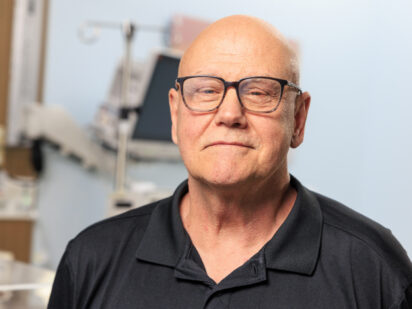

Thomas Carver, DO, neonatologist, did not initially set out to become one. He had his sights set on becoming a physical therapist when he went to college. But as his classmates were accepted into medical school, a professor introduced him to a physician he could shadow for six months.
“While I was shadowing, I decided that medicine is what I wanted to do,” Dr. Carver said.
His passion for pediatrics and neonatology found him years later while serving as an Army troop physician in Alaska. When the Air Force hospital couldn’t keep up with the volume of dependent care, Dr. Carver’s clinic opened its doors to military families. His two partners weren’t interested in seeing children, but he welcomed the opportunity.
“I was able to see all the kids every afternoon, and fell in love with the specialty of pediatrics,” Dr. Carver said.
That love continued to grow during his residency at Fitzsimmons Army Medical Center, where his first month as a pediatrics resident was in the neonatal intensive care unit (NICU). His own first son was born premature, and his second son arrived early as well, while Dr. Carver was on call in the NICU himself. “I got to see him every other night for a month,” he said.
A Great Falls, Montana native, Dr. Carver hadn’t planned on North Dakota. Twelve years into an Army career stationed in Tacoma, Washington, he was ready to reenlist when his unit was reassigned and told they’d deploy to Haiti. He put together a list of medical supplies to treat children there, only to be told he wouldn’t be treating children at all. He submitted his paperwork to get out.
After interviews in Ohio, Washington and California didn’t feel like the right fit, a recruiter mentioned an opportunity in Minot. Dr. Carver laughed at first but was convinced to interview.
“Minot was the kind of town that my wife and I grew up in. It gave us a homey feel, and we knew that’s where we wanted to raise our kids,” he said.
After coming to Minot, Dr. Carver helped launch St. Joseph Hospital’s NICU. Since it was a new offering, he wasn’t busy at first while the unit built its patient base, so his colleague, Michael Holland, MD, asked if he would help out in pediatrics.
What began as a favor became a defining feature of his career: for 26 years, Dr. Carver practiced in both neonatology and outpatient pediatrics, a rare combination that let him provide continuity for many of his former NICU patients.
“About 80% of the NICU graduates came to me for follow-up in pediatrics. I got to watch them grow up. It’s something that people don’t always get a chance to do,” Dr. Carver said. “Watching these kids grow, learn and thrive meant a lot to me, especially because some of them were pretty sick when they were born.”
Dr. Carver was also among the first physicians in North Dakota to adopt the medical home model, which lengthened appointment times, coordinated care with schools and specialists, and gave families a stronger voice in their children’s care. Care plans were built into charts so emergency room physicians could quickly reach a patient’s specialist. “It gave the parents a little more say in what went on with their child,” he said.
Much of that patient advocacy was shaped by his own family experience. Dr. Carver’s first son, born severely ill, faced dismissive care that left a lasting impression. One specialist, reviewing an MRI, told Dr. Carver directly to expect nothing from the boy’s future. “I swore I would never practice that way,” he said.
Instead, he spent more than two decades on North Dakota’s task force for children with special needs, served on the March of Dimes regional board, was appointed by the governor to the state medical board for eight years, and regularly attended school meetings to advocate for accommodations on behalf of his patients.
Across three decades, Dr. Carver trained and mentored countless students, residents and nurse practitioners, with one lesson above all: listen to the patients and do a thorough physical exam. “I had a rule that if I came in and you were listening to somebody’s heart and lungs through an article of clothing, you failed the rotation,” he said. He also tailored his teaching to each student’s goals, hoping they’d carry forward compassion and patient-centered care.
Colleagues and patients remember Dr. Carver for caring far beyond the clinic walls. When a patient’s family couldn’t afford transportation to see a specialist in Bismarck, he used his day off to drive them there himself. He also arranged self-defense training for NICU and labor and delivery nurses, believing everyone, nurses included, should know how to protect themselves.
From the time he started until his retirement in August 2026, Dr. Carver has watched neonatology transform. He points to vaccines as one of the biggest advancements. “A lot of the diseases we used to see, we just don’t see anymore because of vaccinations.” He also credits improvements in ventilation and nutrition as standout changes over his career.
Reflecting on his career, Dr. Carver points to the medical home model, advances in the NICU, and, most of all, the nurses he worked alongside for decades as what he’s most proud of. “I hope to be remembered for the way I cared for those I worked with,” he said.
In retirement, Dr. Carver plans to keep learning, this time about the environment and local rivers and aquifers. He’s looking forward to spending time at the family farm with his three granddaughters and to supporting his wife as her “crew chief” at aid stations while she runs marathons. “She always took care of me,” he said. “Now it’s my turn.”