701-418-8000


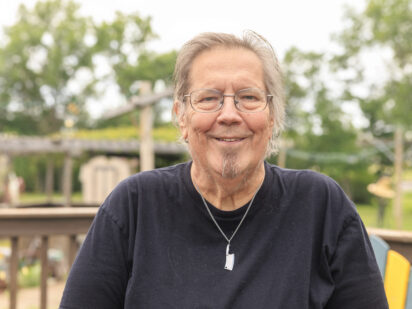

Spending his professional career as a chef, Brian Szablewski always enjoyed food, whether preparing it for others or sharing a meal with his loved ones. Food brought him and his wife, Gwen, to North Dakota from Wisconsin when Brian was offered the opportunity to take over dining services at Minot State University.
After more than 25 years in the industry in North Dakota alone, Brian retired and has been enjoying that chapter of his life since. However, one night, when Brian and Gwen were sharing a meal at home, things changed dramatically.
“Gwen and I were talking while we were eating, and then suddenly I couldn’t swallow or speak,” said Brian. Immediately, they knew something was seriously wrong; 911 was called, and Brian was rushed to the hospital.
Trinity Health’s First Response Ground team identified immediately that Brian was having a stroke. They notified the hospital that a potential stroke patient was coming in.
The Emergency/Trauma Center was prepared for Brian’s arrival. Upon arriving at Trinity Health Hospital, Brian went for a CT scan of his head. Based on the results of the scan and the fact that he presented quickly after his symptoms started, he was deemed eligible to receive a clot-busting medication.
Additional imaging tests determined that Brain was suffering from a stroke due to a large clot in one of the main arteries in his brain. Barry Amos, DO, Interventional Radiology at Trinity Health, was consulted and recommended taking Brian for a procedure to remove the clot from his brain that was causing the stroke. The results were almost immediate.
“Within 24 hours, I was able to talk again. It was a night-and-day difference. Members of my care team noticed it too,” said Brian.
Although Brian made significant improvements within 24 hours of recovering from his stroke, he quickly realized he still had a long way to go to return to the life he knew before. Simple tasks like getting out of bed or walking independently were still difficult. As Brian worked with Trinity Health’s Acute Inpatient Rehabilitation team, he began to progress in those areas as well.
“My care team would help me out of bed, and we’d take long walks down the hallway. They encouraged me to spend time sitting in a chair, eating, reading and watching TV instead of staying in bed all day,” said Brian.
Therapy included a variety of exercises designed to strengthen both his body and cognitive abilities.
“We played games on sheets of paper, and they had me do things like look out the window and point to the ceiling. Day by day, I was able to do more of those things. They also helped me work on my eating habits by encouraging me to take smaller bites. By the next day, my trouble swallowing food was gone,” said Brian.
For nearly two weeks, that was Brian’s life. Despite being in a good place mentally and physically during his recovery, the emotional challenge of being away from home was often the hardest part.
“I just wanted to go home,” said Brian. “But I realized that I couldn’t go home until I was able to do the things I needed to do in rehab.”
Motivated by that goal, Brian continued to focus on his recovery. Within four days of working with the Acute Inpatient Rehabilitation team, he felt he was at a turning point and getting closer to his goal.
“Within four days, I felt like I was making progress, but I knew I wasn’t quite ready to come home yet. I still needed help with walking and other daily activities,” said Brian.
Thanks to an individualized care plan and a compassionate, supportive care team, he was not only able to go home but also felt confident in his ability to live his life again.
“My care felt very personalized and tailored to my goals. My care team was very informative, easy to talk to and extremely knowledgeable. By the time I left, there wasn’t anything I couldn’t do,” said Brian.
Today, Brian still feels a night-and-day difference in terms of where his health is before and after the stroke. His recovery is a credit to the quick decision to seek care at Trinity Health Hospital the night of his stroke, his positive mindset throughout the recovery process, and the strong support from his loved ones and his care team at Trinity Health.
For anyone facing a similar journey, Brian’s advice is simple: “Don’t give up. Every day can be a struggle, but there is light at the end of the tunnel. If you keep that mentality, you can survive it and get better.”
Brian’s story is a powerful reminder that recognizing a stroke quickly can change everything. Trinity Health uses the acronym BE FAST to help people recognize the warning signs of a stroke and act quickly:
- Balance – Sudden loss of balance or coordination.
- Eye – Double vision, loss of vision affecting one eye or visual field.
- Face drooping – Is the person’s smile uneven or lopsided? Does one side of the face droop or is it numb?
- Arm weakness – Is one arm weak or numb? Ask the person to raise both arms. Does one arm drift downward?
- Speech difficulty – Is the Person’s speech slurred? Is the person unable to speak or hard to understand?
- Time – If you observe any of these signs, it’s time to call 911 or get to the nearest stroke center or hospital.