
 701-418-8000


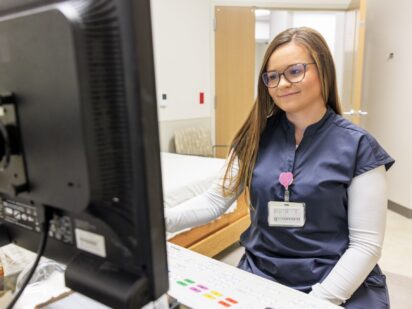

The first time Taylor Hanna encountered her future career, she questioned what was happening. As a Certified Nursing Assistant with Trinity Health, a neurodiagnostic tech ran an electroencephalogram (EEG) on a patient she was working with. Being unfamiliar with the test procedure, Taylor raised questions.
“I asked the tech, ‘What are you doing?’ because I have never seen anything like that,” Taylor said. “They explained to me that they were checking to see if the patient was having seizures. I knew that somebody tested for seizures, but I didn’t know how they did it.”
An EEG is just one part of neurodiagnostics. At Trinity Health, there are Neurodiagnostic Tech I, II and Senior Tech levels. Tech I performs tasks such as hearing tests for newborns, EEGs and checks for slowing in patients with dementia.
Tech II works alongside surgeons to help protect nerves during procedures and performs nerve conductions to check for conditions such as carpal tunnel syndrome, neuropathy, ALS and more. Senior Techs can perform all tests in the department.
After learning more about the field through her first interaction with a Neurodiagnostic Tech, Taylor’s interest piqued. She began researching the field and continuing to learn more about it, where she began to feel like this could be a career path for her eventually.
Following her work as a CNA, Taylor became an Electrocardiogram Tech at Trinity Health before pursuing neurodiagnostics. While she was excited to start a new chapter, one she felt ready for, Taylor knew the transition would be intimidating. That feeling, however, quickly subsided thanks to the support she received.
“It was a little intimidating because when people think about neurology, they think it’s scary. I didn’t know anything when I started, but all of the neurologists were friendly and willing to help. No question was a silly question,” said Taylor.
On-the-job training was a significant part of the process for Taylor as she worked towards becoming a Neurodiagnostic Tech I. With the support of Trinity Health, she was able to become certified in EEG, nerve conduction and surgical monitoring. While these certifications are available for team members to earn at their own pace, Taylor’s passion for the field began building rapidly and she finished all of them within a year and a half.
These certifications include online modules, tests, hands-on learning and interactive videos, making it possible to learn while working.
Since transitioning to the neurodiagnostic field, Taylor has continued to focus on learning and growth within Trinity Health, where she currently holds the position of Neurodiagnostic Tech II. While the role builds on Tech I responsibilities, it carries more trust from providers, who rely on Tech IIs to make judgments and manage complex procedures.

“To be a Tech II, you have to know things like how to troubleshoot the machines and what could cause unusual readings. Doctors put a lot of trust in you, especially when you are on call,” said Taylor.
With that increased responsibility has come a stronger sense of purpose and fulfillment in her work. Taylor says transitioning to the neurodiagnostic field has been one of the most rewarding steps in her career.
“I’m more than satisfied with where I’m at in my career. I’m learning something new every single day with neurology and you don’t always get that in other fields. We also don’t do the same tests every day. There are three or four different tests we can do in the same workday,” said Taylor.
Taylor says what keeps her most engaged in the field is the variety and constant learning that come with each day. She adds that neurodiagnostics is especially appealing for CNAs or those with a nursing background who enjoy hands-on, patient-focused work.
“The days are always interesting, and no patient is the same. If you are feeling stuck with the same patients, we do it all and have a lot of variety in our days. If you come from a nursing background, there are plenty of opportunities to use those skills as well.”
Beyond the variety of the work itself, Taylor says one of the best parts of her role is the people she works alongside. The neurodiagnostic team, she explains, is a close-knit group that supports one another and continues to learn together each day.
“We’re a small department with four techs and the neurologists. It’s family-like. If someone needs help, we all pitch in. We get to work hands-on with doctors and learn from them. There’s room for advancement, and education is continuous,” said Taylor.
From the moment Taylor first encountered an EEG to her current role as a Neurodiagnostic Tech II, her career journey has been defined by curiosity, dedication and continuous learning. What began as a simple question evolved into a passion for a field that offers variety, challenge and the opportunity to make a real difference in patients’ lives. Along the way, she has grown not only in technical skills but also in confidence and purpose, supported by a close-knit team and a culture that encourages collaboration and professional development.
Today, Taylor’s story illustrates how exploring new opportunities, embracing growth and pursuing one’s interests can lead to a deeply rewarding career. Her journey serves as a reminder of the impact that supportive teams, ongoing education and hands-on experience can have in shaping a fulfilling path at Trinity Health.