
• Skip to primary navigation
  • Skip to main content
  • Skip to primary sidebar

Trinity Health

Close Search

How can we help you?

Popular Searches...
  • Find a Doctor
  • Find a Location
  • Find a Job
  • Pay My Bill
  • View Patient & Visitor Information
  • Access Patient Portal
  • Make a Donation
  • Contact Trinity Health
  • Find a Provider
  • Find a Location
  • Areas of Care
  • Patients & Visitors
  • My Patient Portal
  • Pay My Bill
  • Ways to Give
  • News & Events
  • Careers
    Home
  • Archives for Stroke Care

Stroke Care

Trinity Health Nationally Recognized for Commitment to High-Quality Stroke Care


August 6, 2026

Trinity Health is excited to announce it has received the American Heart Association’s Get With The Guidelines® – Stroke Rural Recognition Gold Plus award. Additionally, Trinity Health also received the American Heart Association’s Get With The Guidelines – Stroke Gold Plus with Target: Stroke Honor Roll Elite achievement award.

Get With The Guidelines brings the expertise of the American Heart Association and American Stroke Association into hospitals nationwide, helping ensure patient care is aligned with the latest research. Get With The Guidelines – Stroke is an in-hospital program designed to improve stroke care through consistent adherence to these guidelines, which can minimize long-term effects of stroke and help prevent death.

“This national recognition reflects the dedication our care teams bring to every stroke patient who comes through our doors,” said Ben Anderson, Chief Nursing Officer/VP of Patient Care at Trinity Health. “Every second is crucial when it comes to stroke care, and this achievement is a testament to the protocols, training and collaborative teamwork that allow Trinity Health to act quickly and deliver the best possible outcomes for the region we serve.”

Stroke is the No. 4 cause of death and a leading cause of disability in the U.S, according to the American Heart Association’s 2026 Heart Disease and Stroke Statistics Report. A stroke occurs when a blood vessel supplying the brain is blocked by a clot or ruptures, preventing blood and oxygen from reaching brain tissue. When this happens, brain cells begin to die. Early detection and rapid treatment are critical to improving survival, minimizing disability and supporting faster recovery.

People who live in rural communities live an average of three years fewer than their urban counterparts and have a 40% higher likelihood of developing heart disease and face a 30% increased risk of stroke mortality, according to an American Heart Association’s presidential advisory on rural health. Trinity Health is committed to changing that.

The American Heart Association recognizes the importance of healthcare services provided to people living in rural areas by rural hospitals, which play a vital role in initiating timely, evidence-based care. For that reason, all rural hospitals participating in Get With The Guidelines – Stroke are eligible to receive award recognition based on a unique methodology focused on early acute stroke performance metrics.

This recognition goes to hospitals for their commitment to acute stroke care excellence, demonstrated through performance on guideline-directed measures including intravenous thrombolytic therapy, timely hospital inter-facility transfer, dysphagia screening, symptom timeline and deficit assessment documentation, emergency medical services communication, brain imaging and stroke expert consultation.

“Patients and healthcare professionals in North Dakota face unique healthcare challenges and opportunities,” said Karen E. Joynt Maddox, M.D., MPH, chair of the American Heart Association Quality Oversight Committee and co-author on the Association’s advisory on rural health. “Trinity Health has advanced the important work of improving care for all Americans, regardless of where they live.”

This recognition reflects Trinity Health’s unwavering dedication to ensuring that stroke patients receive timely, evidence-based care aligned with nationally recognized clinical guidelines, ultimately saving lives and preserving function and quality of life for stroke victims.
Filed Under: News Releases Tagged With: Stroke Care, Stroke Center, Stroke Prevention, Trinity Health, Trinity Health Stroke Program

A Guardian Angel, a Magnet and the Screening That Changed Everything


July 24, 2026

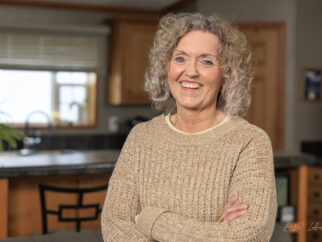
When Tami Spiros walked into her carotid screening, part of Trinity Health’s MyChoice Health Checks, she expected nothing more than a routine check-off on her retirement to-do list.

The recently retired school counselor had just wrapped up 30 years in education and was settling into her first August off in as many years, taking a girls’ trip to Hawaii before working through her retirement to-do list. A carotid artery screening was one of those items.

“I went in feeling like this is just a routine,” Spiros said. “I’m not an overall worrier, so I didn’t feel like they were going to find anything wrong with me.”

But Spiros wasn’t screened on a whim. She was screened because she’d lost both of her siblings, and because two close friends at Trinity Health refused to let her put it off any longer.

Spiros’s sister, Teri, died in 1997 at age 36, four days after giving birth to her second child. An autopsy reviewed by prominent cardiologists found no structural abnormalities, just an unexplained cardiac arrhythmia. She passed away in her sleep, leaving behind a newborn, a two-year-old and a husband.

In April 2021, Spiros’s brother suffered a fatal stroke while sitting in a chair at his Colorado home, preparing for a school meeting on his computer. Not long before, the two had discussed adding him to a power of attorney, since he was the youngest sibling and would likely outlive the others. Three weeks later, he was gone.

“It didn’t hit me at that point that I was the only surviving child. It was an overwhelming experience,” Spiros said.

At her brother’s celebration of life, Patti Detlaff, Radiology Supervisor at Trinity Health, knew how important it was for Spiros, who was at high risk because of her family history, to get screened. “Patti gave me a magnet with information about the screening program and said, ‘You’ve got to do this. Just call, set up an appointment and go get these screening tests done,'” Spiros said.

Jim Coffin, Director of Radiology at Trinity Health and a lifelong friend of Spiros, delivered a similar message: “Tell me you’re going in to get the screening. It’s not an option. With your family history, you are at risk.”

Despite a full plate—the celebration of life, stepping into retirement—Spiros prioritized her health and scheduled the screening for August.

The appointment was supposed to be routine: five standard screenings. As the fourth was about to begin, the technologist asked Spiros to step out for a few minutes. That’s when things changed.

“The technologist came back after a bit and said, ‘We found some blockage on your left carotid artery.’ Without any hesitation, I was sent straight to Trinity Health Hospital,” Spiros said. She was surprised she needed the emergency room when she felt no symptoms at all. “I wasn’t overly concerned at this time because I felt fine. I had no symptoms, but I was definitely taking it seriously.”

At the hospital, staff moved fast, taking her back immediately. “Everyone explained to me what was going on, and they kept me informed as to what they were doing and why,” Spiros said.

Jerilyn Alexander, Stroke Program Coordinator at Trinity Health, said cases like Spiros’s are exactly why screening matters, especially for people with a family history of stroke or heart disease. “It’s vital for you to get those screenings done even from a young age, because we are seeing younger and younger people having strokes all the time,” she said.

That family-history risk factor is central to how physicians evaluate carotid disease, said Peter Mikhail, MD, FRCS (C), FACS, Cardiothoracic Surgery at Trinity Health. Carotid blockages, as in Spiros’s case, are notoriously silent until they aren’t. “Most people don’t get screened, especially if they have risk factors,” Dr. Mikhail said. “Then they reach a point where the blockages are very thick, or they have mobile elements in them, and they come into the emergency room with a stroke. If they had been screened and kept on regular follow-up, we could intervene before they had a stroke.”

That’s precisely the outcome Spiros avoided. “We prefer to operate on people with severe blockages who have not had a stroke,” Dr. Mikhail said. “We want them to do well and not have any functional deficit.”

Spiros’s recovery reflected the benefits of early intervention. “My recovery was great. My doctor was even surprised by how quickly I recovered,” she said.

Looking back, Spiros credits Detlaff with more than strongly encouraging an appointment. “Patti is my guardian angel,” she said. “I owe my life to her for getting me to go in for the screening.”

She’s since watched the ripple effect spread through her own circle; friends who got screened after hearing her story, and her oldest son, who now goes in for regular checks of his own. “It’s important that people take advantage of the screening that’s offered by Trinity Health, because you just don’t know what you’re going to find,” she said. “For me, it was a life-saving visit.”

For Spiros, the lesson goes beyond the screening itself. “Life is short,” she said. “I’ve learned the hard way, losing my siblings. Take care of your health and enjoy every day.”

For more information about Trinity Health’s MyChoice Health Checks, click here or call 701-418-8130 to schedule an appointment in Minot, or call 701-572-7711 to schedule an appointment in Williston.

See below for a video on Tami’s story.

Filed Under: HealthTalk Tagged With: Carotid Artery Disease Screening, MyChoice Health Checks, Stroke Care, Stroke Center, Trinity Health, Trinity Health Stroke Program

sidebar

Copyright © 2026 · Trinity Health on Genesis Framework · WordPress · Log in